
2026-10-10 09:15:06
Two factories can buy the same welding machine and get completely different results. The variable is usually the fixture. A well-designed welding fixture controls distortion, repeats the same position cycle after cycle, and lets the operator focus on quality instead of fighting the part. This guide explains how to choose a welding fixture for industrial production.
A welding fixture is a device that holds workpieces in a fixed, repeatable position during welding. It locates each part precisely and clamps it against the forces that welding introduces, such as thermal expansion and contraction.
The fixture does two jobs at once. It guarantees that every assembly is dimensionally consistent, and it removes the need for the operator to hold parts by hand, which improves both safety and cycle time.
Welding generates intense local heat. As the metal cools, it contracts and pulls the joint out of alignment. A rigid fixture resists that movement and holds the assembly within tolerance. Without one, distortion accumulates and parts must be reworked or scrapped.
Fixtures also standardize operator technique. When the part position is fixed, the weld path is identical every cycle, which makes quality predictable and inspection simpler.
Product structure and material. The fixture must match workpiece geometry, thickness, and the material's thermal behavior. Thin sheet metal and heavy plate demand very different clamping forces and support strategies.
Welding process. Manual MIG/MAG, TIG, spot, and laser welding each require different access and heat management. A fixture that works for a manual torch may block the beam path of a laser workstation.
Production volume and cycle time. Low-volume, high-mix production favors flexible modular fixtures, while high-volume lines justify dedicated fixtures with quick-change tooling.
Changeover requirements. If several variants share a line, the fixture needs quick-release elements so changeover does not become the bottleneck.
Dedicated fixtures are built for one specific part and offer the highest repeatability. They suit stable, high-volume programs.
Modular fixtures use a base plate with standard locating and clamping elements, allowing the fixture to be reconfigured when the part changes. They are ideal for prototypes and mixed production.
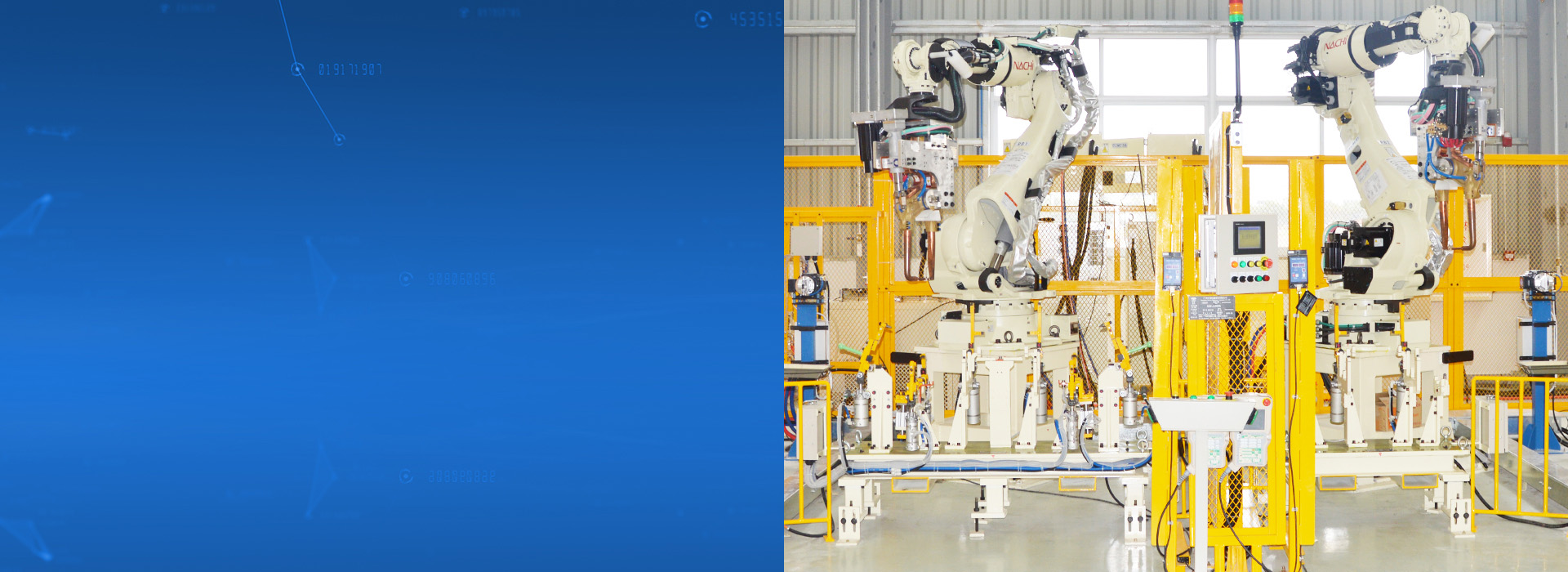
Robotic welding fixtures are designed to work with automated cells. They position the part for the robot, often using a rotary axis or positioner so the torch can reach every joint from the optimum angle.
Locating pins should reference the part from datum points that the customer's drawing already defines, so quality checks line up with design intent. Clamps should hold the part without marking visible surfaces. Where distortion is severe, the fixture may need integrated cooling or a sequenced clamping order that locks the joint before heat spreads.
Access is another common failure point. The fixture must leave enough clearance for the torch, the gas nozzle, and the robot arm at every weld, or the operator will end up welding out of position.
Automated fixtures make sense when production volume is high, quality requirements are strict, or the part is too heavy or too hot for safe manual handling. In these cases, the fixture is integrated with a welding robot and a positioner to create a complete workstation.
An automated fixture also needs sensors and interlocks so the machine cannot weld an incorrectly loaded part — a small addition that prevents costly scrap.
Choosing a welding fixture is a matter of matching the design to product geometry, welding process, and production volume. Start by defining the tolerances the assembly must hold, then select locating, clamping, and access features that make those tolerances repeatable. Done well, the fixture becomes the foundation of consistent weld quality rather than an afterthought.
Partnering with a supplier experienced in both fixtures and automated workstations helps ensure the fixture works as part of the whole production system, not just as a standalone tool.
Connect With Us


Phones: +86 136-0262-0678
Email: dayi-tech@dayi-techequip.com
Whatsapp: +86 136-0262-0678
ESP-B Factory Add: No.10,Yucai Road ,Dalingshan Town, Dongguan City, Guangdong Province, China 523820
Welding Equipment Factory Add: Xiaji 2nd Road, Xintang Town, Zengcheng District, Guangzhou City, Guangdong Province, China 511348
© 2026 Dongguan Dayi Technology Co., Ltd. All rights reserved.
Privacy Policy | Terms and Conditions